| What you have | Calculator input | What to leave out |
|---|---|---|
| A known finished fill weight | Finished fill weight / volume; select g or weight oz | Container, lid and other permanent components |
| Wax already weighed without fragrance | Unscented wax weight / volume | Do not call this the finished fill |
| A volume measured to the intended fill line | Select mL and enter a matching documented or measured density | Do not apply a second headspace reduction |
Get the weights for your batch
Choose the input basis, amount per candle, unit and quantity. Fragrance load here means fragrance weight divided by unscented wax weight. Read the two ingredient results separately.
For a finished-fill target:
Total mixture = fill per candle × quantity
Wax = total mixture ÷ (1 + fragrance load ÷ 100)
Fragrance = total mixture − wax
See the existing soy-wax batch guide for mixed jar sizes and the fragrance-basis guide for percentage conversions.
Use the fill line you actually intend
CandleScience distinguishes overflow volume from estimated wax weight to a fill line in its Container Info reference. In volume mode, enter the volume to your chosen line and a density matching the actual material and measuring conditions. A wax name alone does not establish that density.
Does ninety percent of the height mean ninety percent of the volume?
That shortcut works for a constant inside cross-section. If the walls taper, record the intended line itself. Do not turn a height fraction into a volume multiplier.
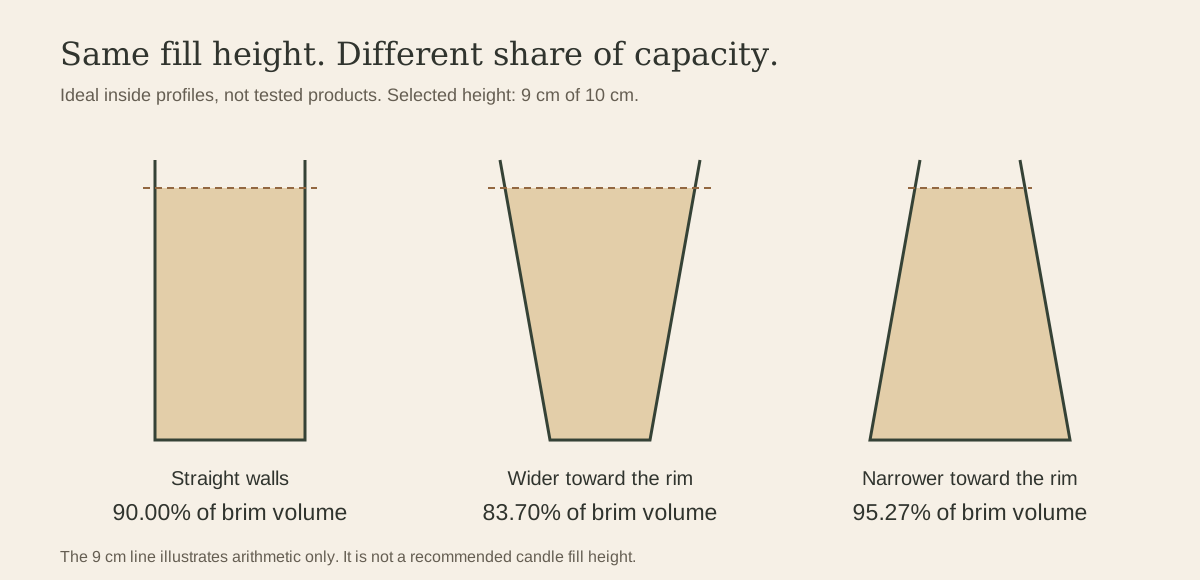
Consider an ideal jar with a flat inside base, straight sloping walls and circular horizontal sections. Its inside radius is 2 cm at the base and 4 cm at the rim. Inside height is 10 cm; the selected line is 9 cm above the base. These are hypothetical dimensions, not measurements of a commercial vessel.
The full model holds 293.22 mL. At the selected line it holds 245.42 mL, or 83.70% of the full volume. Multiplying brim capacity by 90% would instead give 263.89 mL, 18.47 mL above the model’s volume at that line. That extra volume comes from treating the wider upper section as though every centimetre of height held the same amount.
The direction of the taper matters. Reverse the two radii while keeping the same height and line, and the selected volume becomes 95.27% of full capacity. A straight-sided model gives 90.00%. The three selected cases show why one percentage cannot represent both a height mark and a volume allowance across these shapes.
| Ideal inside shape | Base radius | Rim radius | Volume below the 9 cm line | Share of brim capacity |
|---|---|---|---|---|
| Straight walls | 3 cm | 3 cm | 254.47 mL | 90.00% |
| Wider toward the rim | 2 cm | 4 cm | 245.42 mL | 83.70% |
| Narrower toward the rim | 4 cm | 2 cm | 279.35 mL | 95.27% |
Every row has a selected inside height of 10 cm. The 9 cm line is a calculation input, not a recommended candle fill height. No vessel was measured, no wax was melted, and no equipment was operated.
Carry the checked volume into the calculator
For the outward-tapering example, the number to carry forward is 245.42 mL. It is already the model’s volume below the chosen line. Entering 293.22 mL would describe the brim; entering ninety percent of that brim volume would describe a different line. Write “volume to the 9 cm line” beside the input so the meaning survives when you reuse the record.
Geometry supplies millilitres. Without a matching actual-mixture density, grams for this example remain unknown. Use a reliable net fill weight directly when available.
A curved shoulder, rounded inside base or changing wall slope breaks this particular model. Outside dimensions include the vessel wall and cannot replace the inside measurements. If those details are unknown, do not force the catalog dimensions into the formula. Obtain the actual usable volume or a tested net fill weight for the intended line, then return to the matching input mode.
Calculation record
For straight sloping walls, let a and b be inside base and rim radii, H inside height, and h fill height. Centimetres give millilitres. This is standard geometry.
k = (b − a) ÷ H
V(h) = π × [a²h + akh² + k²h³ ÷ 3]
Volume fraction = V(h) ÷ V(H)
Substitute a = 2, b = 4, H = 10 and h = 9. Displayed values are rounded. This model does not predict contraction, losses or burn behavior.
FAQ
How much wax do I need for an 8 oz candle?
A measured 8 oz finished-mixture target at a selected 6% wax-based load gives 7.55 oz wax and 0.45 oz fragrance, rounded. A jar label alone is insufficient.
Should I multiply by 0.86?
Identify its purpose first. Density conversion and a fraction of brim capacity do different jobs. This calculator supplies neither automatically. Do not reduce a volume already measured to the chosen line.
Can this calculator select a safe fill height or wick?
No. Follow the exact vessel and material instructions and test the complete formulation. The hypothetical 9 cm line is not a safety instruction.
Sources and limits
CandleScience, Container Info; OpenStax, Calculus Volume 1, section 6.2; Wolfram MathWorld, Conical Frustum. Read October 25, 2026. Hypothetical geometry, not physical measurements or a claim of global exclusivity.
Disclosure: This site may earn a commission from qualifying purchases through affiliate links. This calculation does not require a purchase.